
I. Introduction: Why Your Boundary Wire is the Unsung Hero
Think of your robotic lawnmower as a sophisticated athlete and the boundary wire as its nervous system. This seemingly simple copper strand is what transforms your expensive smart mower from a confused gadget into an autonomous lawn-care champion. Yet, as thousands of frustrated 2024-2025 buyers discovered, choosing the wrong wire can turn your “set it and forget it” dream into a weekend troubleshooting nightmare.
According to analysis of customer complaints across Amazon, eBay, AliExpress, and Shopee, the majority of robotic mower malfunctions trace back to one culprit: inadequate boundary wire. The good news? The 2026 market brings improved options and clearer standards. This guide will help you navigate the evolving landscape, avoid common pitfalls, and select a boundary wire that delivers years of flawless performance.
II. Learning from Mistakes: Top Buyer Regrets (2024-2025 Analysis)
Before looking forward, let’s examine what went wrong for countless homeowners. These real-world frustrations reveal exactly what to avoid:
The Fragility Problem: The most common complaint centered on insulation that failed within a single season. Thin PVC jackets cracked under UV exposure, allowing moisture to creep in and corrode the copper core. This often created “ghost breaks”—invisible corrosion points that caused intermittent “wire missing” errors without a complete break, making diagnosis maddening.
The Installation Nightmare: Users consistently reported wrestling with memory-laden wires that refused to lay flat, requiring excessive stakes. Others battled with poorly wound spools that tangled instantly. One Amazon reviewer lamented, “I spent more time untangling this wire than my mower spent cutting grass all season.”
The Compatibility Conundrum: Many “universal” wires failed to work with specific brands. Cheap gel connectors dried out, and Copper-Clad Aluminum (CCA) wires—often misrepresented as pure copper—caused persistent signal issues, especially in larger yards.
III. The 2026 Gold Standard: Your Ideal Robotic Lawnmower Boundary Wire Specs
Translating these pain points into positive criteria creates your 2026 shopping checklist:
A. Unbreakable Defense: Insulation & Durability
Your wire’s jacket is its first line of defense. In 2026, look beyond basic “outdoor-rated” claims.
- Material Matters: High-Density Polyethylene (HDPE) has emerged as the superior choice over standard PVC, offering better UV, temperature (-40°C to 80°C), and chemical resistance. For ultimate protection, some brands now offer a composite jacket with a nylon mesh layer for cut resistance.
- Thickness is Key: The “Heavy Duty” label should be backed by a minimum 2.0mm outer diameter. This provides meaningful protection against accidental trims, rodent teeth, and weathering.
- Animal Resistance: If you have pests, seek wires with a protective metal braid (like RG-59 coaxial cable) or a proprietary chemical additive that makes the jacket taste unpleasant to rodents.
B. The Beating Heart: Conductor Quality is Everything
The metal inside is what carries the signal. Compromise here, and you compromise everything.
- Zero Tolerance for CCA: Copper-Clad Aluminum (CCA) is the single biggest cause of long-term failure. The aluminum core oxidizes rapidly when exposed to moisture, increasing resistance and leading to signal dropouts. Demand 100% pure copper or tinned copper. Tinned copper (copper coated with a thin layer of solder) offers superior corrosion resistance at connection points.
- Right-Sizing Your Wire (The AWG Guide): Gauge (AWG) determines current-carrying capacity and resistance over distance.
- 16-18 AWG (≈1.0-1.5mm²): Ideal for small to medium lawns (perimeter under 300m/1000ft). This is the most common and cost-effective size, sufficient for most residential setups.
- 14 AWG (≈2.1mm²): The 2026 recommended standard for medium to large lawns (perimeter 300m-600m). It provides lower resistance, ensuring a strong signal throughout the loop with less voltage drop.
- 12 AWG (≈3.3mm²) and thicker: Necessary for estate-sized properties or very long runs (600m+). The lower resistance guarantees reliable operation over extreme distances.
C. Smart Features for Easy Installation
A quality wire is designed to be installed, not fought with.
- Low-Memory Design: The wire should be supple and lay flat straight off the spool, conforming to curves without springing back. This minimizes the number of stakes needed and reduces tripping hazards.
- Tangle-Free Packaging: Look for brands that use a solid, engineered spool with secure end clips, not just a taped coil. This is a hallmark of a manufacturer that cares about the user experience.
- Clear Length Marking: Premium wires include meter/feet markers printed directly on the insulation every meter or few feet, eliminating guesswork during layout.

IV. Beyond the Wire: Critical Compatibility & Connection Checks for 2026
Your wire is part of a system. Its compatibility with connectors and your mower is non-negotiable.
- Robotic Lawnmower Boundary Wire Compatibility Deep Dive:
- Check Your Manual: Brands like Husqvarna, Automower, and some Worx models specify a preferred wire gauge (often 2.5mm² or 14 AWG) for their base station terminals. Using a wire that’s too thin can result in a poor connection.
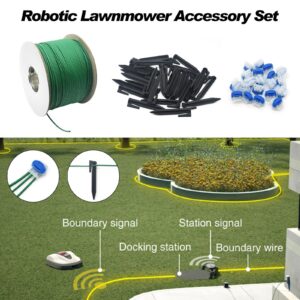
- The 2026 Connector Standard: Basic gel caps are being surpassed by double-sealed, mechanical connectors. The new best practice involves a waterproof solder-sleeve or a crimp connector with an integrated silicone seal, covered by a heat-shrink outer shell with adhesive lining.
- Understanding Resistance and Voltage Drop: For large loops, the total resistance of the wire loop matters. A higher-gauge (thinner) wire has higher resistance, which can weaken the signal at the far end of a large yard. Using 14 AWG instead of 18 AWG can cut loop resistance by over 50%, ensuring a robust signal everywhere. Use online voltage drop calculators if you have an exceptionally large perimeter.
V. Future-Proofing Your Lawn: 2026 Trends to Consider
The boundary wire is evolving. While the core principles remain, these trends are worth noting:
- “Smart” Diagnostics: Some premium wire systems now include a secondary conductor used solely for fault detection, helping to pinpoint break locations more accurately via the mower’s app.
- Eco-Conscious Materials: A niche market is developing for biodegradable insulation made from materials like PLA. Important Note: As of 2026, these trade longevity for environmental benefits and are best for temporary installations or those willing to replace wire more frequently.
- The Wireless Question: While fully wireless systems using RTK GPS exist, they are significantly more expensive and can struggle under heavy tree cover. The reliable, affordable boundary wire will remain the dominant solution for most homeowners for the foreseeable future.
VI. Step-by-Step: Your 2026 Boundary Wire Selection Checklist
Use this actionable list when you’re ready to buy:
- Measure: Calculate your lawn’s total perimeter. Add 10-15% for routing around obstacles, slacks, and connections.
- Inspect the Specs: Verify Pure Copper/Tinned Copper and a minimum 2.0mm outer diameter. Reject any product that doesn’t explicitly state this.
- Choose the Gauge:
- Small/Medium Lawn (<300m loop): 18-16 AWG
- Medium/Large Lawn (300m-600m): 14 AWG
- Very Large Lawn (600m+): 12 AWG or thicker
- Verify Connector Quality: Ensure the splice kit includes waterproof, mechanically robust connectors—not just gel-filled caps.
- Read Smart Reviews: Filter reviews for terms like “2 years,” “durable,” “corrosion,” and “tangle.” Recent, long-term feedback is most valuable.
VII. Installation Pro-Tips for a Flawless Setup
Even the best wire needs proper installation.
- Use the Right Tool: A cable laying tool ($20-40) is the best investment you’ll make. It cuts a narrow, consistent slit for burying the wire 1-3 inches deep, protecting it instantly.
- For Above-Ground: Use plenty of UV-resistant lawn stakes every 2-3 feet, keeping the wire taut. Avoid sharp 90-degree bends.
- Make Perfect Splices: Strip carefully, use the recommended connectors, and ensure they are completely sealed before covering.
VIII. FAQ: Your Top Boundary Wire Questions, Answered
Q: Can I use any electrical wire as a boundary wire?
A: Technically, you can, but you shouldn’t. Dedicated boundary wire is engineered for the specific low-voltage, high-frequency signal of your mower and has the right flexibility, UV resistance, and often, color (green/brown) for blending in.
Q: How do I find a break in the wire?
A: Most mower brands offer a guide. Typically, you use a dedicated wire break locator (a radio transmitter/receiver) or the mower’s own signal to narrow down the break point section by section.
Q: How long should a quality boundary wire last?
A: A properly installed, high-quality pure copper wire with HDPE jacket should last 7-10 years or more. Cheap CCA wire may fail in 1-3 seasons.
Q: Is thicker wire (lower AWG) always better?
A: Thicker wire (12-14 AWG) has lower resistance, which is better for large yards. However, it is more expensive, less flexible, and harder to work with. For a standard suburban lot, 16 AWG is often the perfect balance.
IX. Conclusion: Invest in Peace of Mind
Your robotic mower represents freedom from weekend chores.
Don’t let a subpar boundary wire—the system’s most critical yet inexpensive component—become its point of failure. By choosing a wire with a durable jacket, a pure copper core (14 AWG for most), and quality connectors, you’re not just buying a cable; you’re investing in seasons of uninterrupted, quiet automation.
In 2026, the choice is clear: bypass the bargain-bin CCA wire. The few extra dollars spent on a premium, properly specced robotic lawnmower boundary wire will pay for itself many times over in reliability, saved time, and preserved sanity. Your future self, enjoying a perfectly cut lawn without a second thought, will thank you.